Cultivate essential skills as you engage the relationship between ministry and social justice.
The Leadership Center for Social Justice seeks to equip, inspire, and empower leaders to faithfully and reflectively engage in concrete, contextual ministry for social justice. In the spirit of faith, hope, and love, the Center supports leaders in developing skills in contextually-sensitive, creative, and effective leadership and social praxis.
The Center serves as a hub for critical conversations about a range of contemporary social and political issues, offering spiritual leaders and communities of faith a place for reflective and deeply engaged continuing theological education.
Teaching and Learning in the Midst of Government-Sponsored Violence
In the wake of Immigration and Customs Enforcement’s (ICE’s) occupation of the Twin Cities metro region since early 2026, United Theological Seminary of the Twin Cities has secured a $30,000 grant to help, as the grant proposal states, “process our experiences of this time, both the blessings and the trauma, so that we can remain effective and compassionate educators and draw on our experiences in a way that expands student knowledge.”
The grant will fund a two-year project titled “Teaching and Learning in the Midst of Government-Sponsored Violence.” As part of its goals, the initiative aims to collect and preserve primary sources related to street activism and chaplaincy, and the life and teachings of faith communities as a resource for teaching about theology, worship, arts, and social movements.
With support from the Wabash Center, United’s Leadership Center for Social Justice is working to gather and preserve information about non-violent resistance and resilience efforts that emerged in response to the ICE Occupation in Minnesota.
We invite you to be a part of this project, especially those in Minnesota; please click here to submit resources and materials developed in response to Operation Metro Surge.
Events
The Hawkinson Fund Joins United's Leadership Center
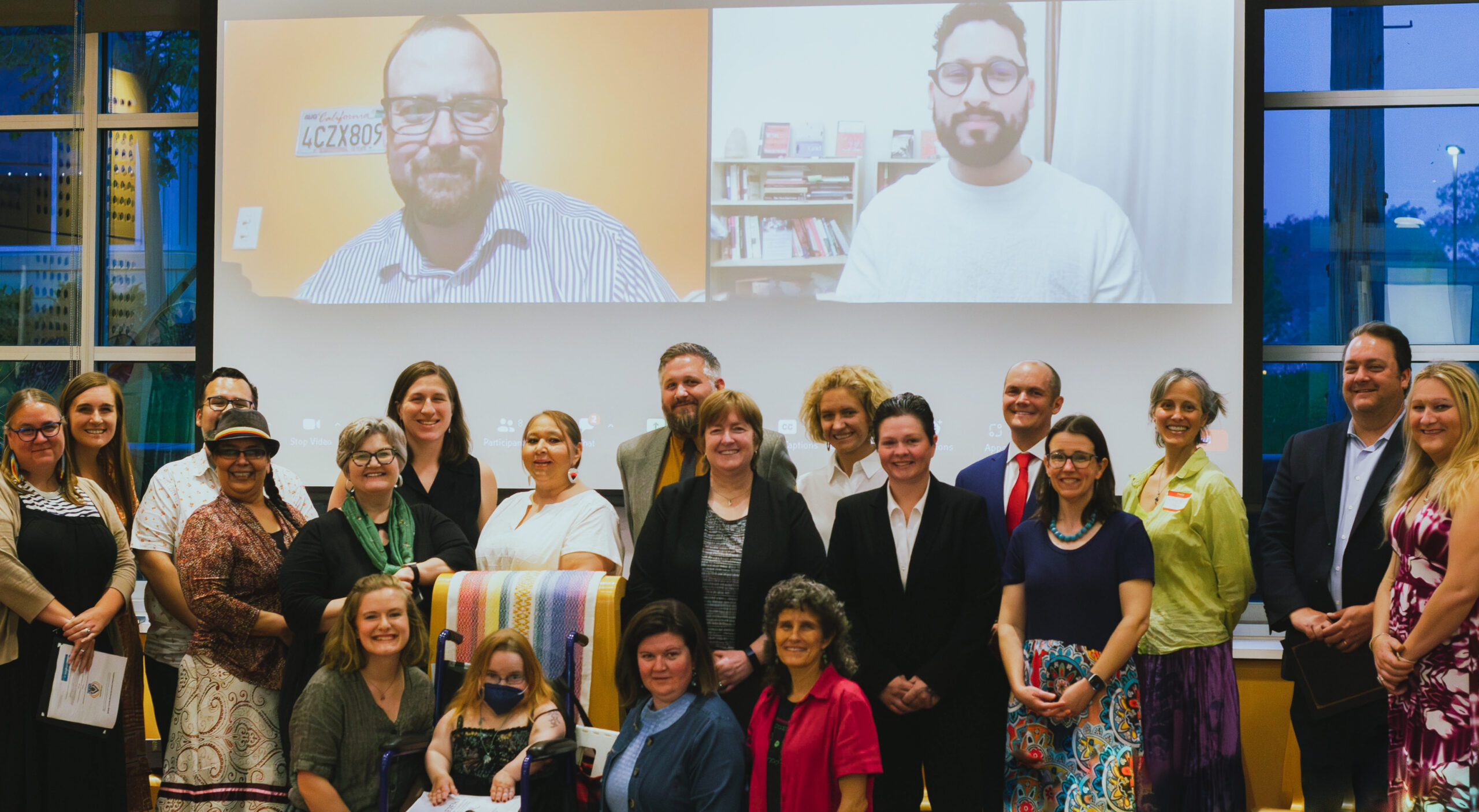
Exciting news: The Hawkinson Fund for Peace and Justice, now part of United’s Leadership Center for Social Justice, offers scholarships to students who demonstrate a commitment to peace and justice. The Fund also offers a yearly honorary award to individuals who have made significant and sustained contributions to peace and justice.
Staff
Rev. Dr. Justin Sabia-Tanis is an associate professor of Christian Ethics and Social Transformation, supported by the McVay Endowment, and the director of the Social Transformation program at United Theological Seminary. He earned his PhD from the Graduate Theological Union in Interdisciplinary Studies in addition to a Master of Divinity degree at Harvard Divinity School and a Doctor of Ministry from San Francisco Theological Seminary. As a pastor, he served congregations in Boston, Honolulu, and San Francisco and was Director of Leadership Development for Metropolitan Community Churches; he is now with the United Church of Christ. In his prior work, he served as Managing Director at the Center for LGBTQ and Gender Studies in Religion (CLGS) and directed communications for the Hawai’i Equal Rights Marriage Project, the National Center for Transgender Equality, and Out & Equal Workplace Advocates. He has taught at the University of Arizona, Pima Community College, Iliff School of Theology, and Pacific School of Religion. He lives in Minnesota with his husband, Henry, and their two dogs.
Grace Pennings Guenthner (she/her) is a Master of Arts in Eco-Justice student at United Theological Seminary of the Twin Cities. She also serves as the Administrative Assistant for the Leadership Center for Social Justice and the Community Outreach and Engagement Coordinator for the Hawkinson Fund for Peace and Justice. Raised on an organic vegetable CSA farm and holding a BA in Geology from Macalester College, Grace brings a deep-rooted connection to the land and a passion for nurturing justice for people and the planet. Before beginning seminary, she spent nearly two years living and volunteering at Holden Village, an intentional community in Washington State’s North Cascades, where she deepened her commitment to community-based, spiritually grounded social transformation. Having grown up in the Grace University Lutheran Church community, where the Hawkinson Fund began, Grace is especially honored to join this important work in the Fund’s new chapter at United.

Research
The Leadership Center for Social Justice currently collaborates with Convergence to assess and evaluate the impact of the Leadership for Social Justice program on congregational vitality.
Affiliated Faculty
Rev. Dr. Gary Green
Associate Professor of Pastoral Theology and Social Transformation, Director of Racial Intelligence Systems
LCSJ on Social Media
Interested in an education that equips you with theological, ethical, and leadership skills to create lasting social justice?
United Theological Seminary of the Twin Cities offers many graduate degrees. The Master of Arts in Leadership in Social Transformation (MAL) degree will equip you with the theological, strategic, organizational, and practical skills to lead social change in a wide variety of organizational contexts, including nonprofits, philanthropy, congregations, community organizing, public service, education, business, politics, social justice advocacy, activism, and other community contexts. The Social Transformation program provides a broad foundation in theology, religious texts, ethics, and leadership as well as focused study in areas specific to a chosen career path.
United’s Master of Divinity in Social Transformation (MDiv) will prepare you to combine the classic functions of ministerial leadership, such as leading worship, preaching, providing pastoral care, forming people of faith, and leading a congregation, with the skills you need to lead and sustain social transformation work within your organization. You’ll be equipped to think critically about socio-political dynamics and reflect constructively on the role of spiritual and theological traditions in movements for social justice. This is a professional, ministerial program that combines the tools and methodologies of social change and activism with practical and constructive theology to prepare innovative and effective leaders for an increasingly pluralistic and complex world.
The MDiv in Social Transformation differs from the MAL in Social Transformation in that it includes training in ministerial competencies as well as social transformation skills.
Pastors and other vocational ministers who have already attained the MDiv (or equivalent) can enroll in the Doctor of Ministry in Social Transformation program (DMin). The DMin can help you grow your current ministry with competence in social transformation, or shift your ministry’s emphasis to social change. Grounded in liberation theology and social analysis, the program focuses on the development and application of practical tools for lasting, effective social transformation. You will craft your own project (dissertation) that addresses an area of needed social change, using your vocational ministry context as a basis for that work.
Now Take the Next Step
Wherever you’re at in your vocational journey, we’re here to help guide you.